
BASEBALL
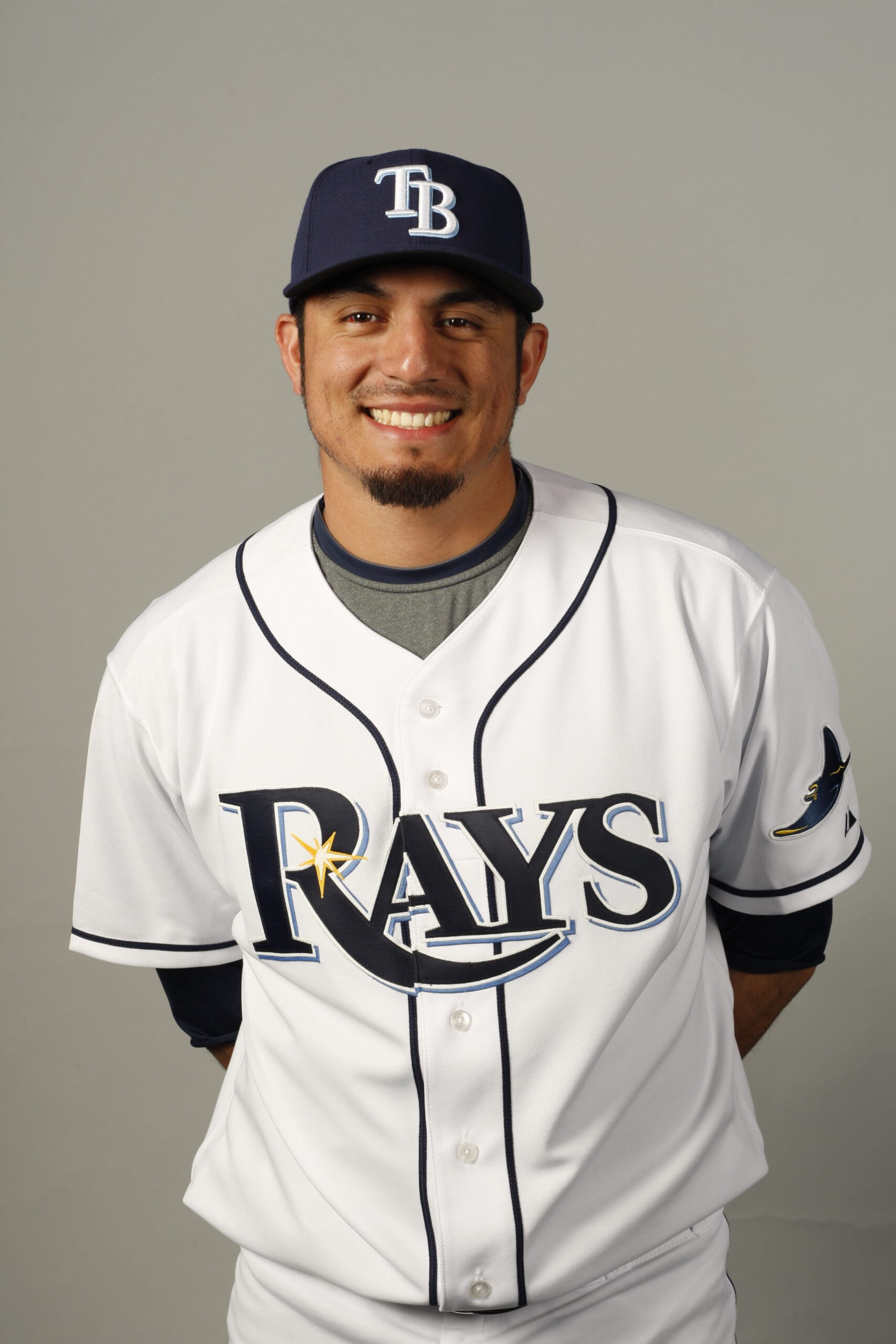
MATT GARZA
As much confidence as Matt Garza carries, it’s hard to believe he didn’t predict years ago he would be on this stage tonight. After all, he was in the second grade when he announced he would one day be a professional baseball player. Garza’s athletic skills shone at Washington Union High School in Easton where he was the standout quarterback on the Panthers football team and a star on the school’s baseball team. The promise of a scholarship led Garza to Fresno State where, in his junior year, he blossomed. A fastball that registered 97 miles an hour on the radar guns drew the attention of professional baseball scouts. Garza earned team MVP honors and was the 2005 Western Athletic Conference pitcher of the year.
In the June 2005 major league draft, Garza was chosen in the first round by the Minnesota Twins. Over the following spring and summer, he raced through the Twins minor league system. In never-before-seen fashion, Garza jumped three levels, winning 14 games against just 4 defeats in A, AA, and AAA. It was capped in August, fourteen months after he left Fresno State, when the Twins promoted Garza to the major leagues. Following the 2007 season, Garza was made part of a blockbuster six-player trade that sent him to the Tampa Bay Rays. The addition of Garza helped the Rays make a dramatic 31-win improvement. A fifth-place team in 2007, Tampa Bay won the American League East in 2008.
In the post-season, Garza was spectacular. In game 3 of the American League Championship series against the Boston Red Sox, he pitched 6 scoreless innings to help the Rays win 9-1. Then in the deciding seventh game, Garza threw 7 innings of 2-hit ball with 9 strikeouts as the Rays won 3-1 to earn their first-ever trip to the World Series. Garza was named the most valuable player of the American League Championship Series. Two years later, during a 15-win season and another division title, Garza achieved a single-game career pinnacle when he pitched a no-hitter and beat the Detroit Tigers 5-0. A 2011 trade took Garza to the Chicago Cubs. Three years later he joined the Texas Rangers. In 2014, free agency led Matt to the Milwaukee Brewers for four seasons before a shoulder injury ended his career after 12 big league seasons.
SOFTBALL
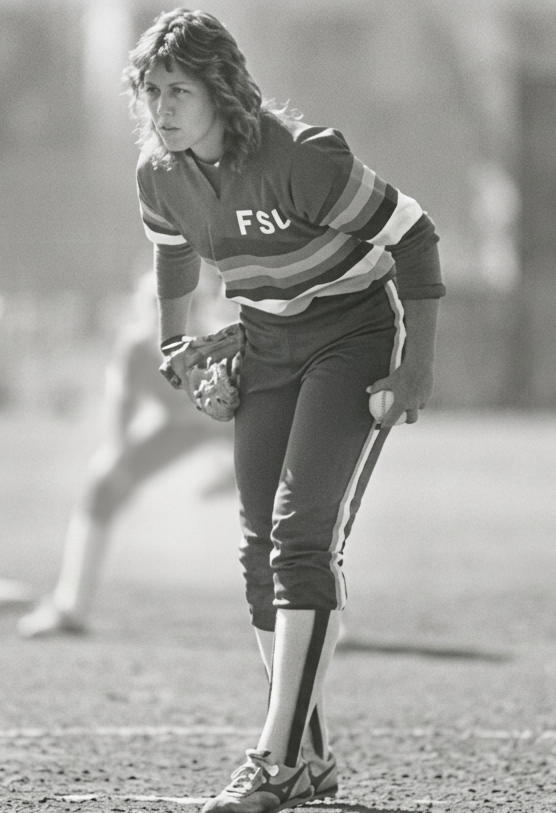
MELANIE PARRENT
The ferocity with which Melanie Parrent’s powerful left arm delivered fastballs and rise balls was like few others in Fresno State softball history. Her name dots the program record books, and those marks still evoke awe almost forty years later. Parrent was recruited from Taft High School by the inaugural coach of the Fresno State program, Donna Pickel. Once at Fresno State, Parrent erupted with aplomb. During her freshman season, 1985, she recorded a school-record tying 0.26 earned run average and helped the Bulldogs to a 53-win season.
On the eve of her sophomore season, 1986, crisis struck the program. Lori Romeiro-Gardner, projected to be the ace of the Bulldogs pitching staff, suffered a serious injury to her left knee and would miss the entire season. The injury left Parrent as the team’s only starting pitcher. Parrent rose to the challenge. New coach Margie Wright pitched Parrent in 48 of the Bulldogs 57 games. The sophomore notched a then-school record 31 wins. Her 45 complete games still stand as a Fresno State single-season record and for two years was an NCAA record. Parrent was chosen league player of the year and was voted Fresno State’s female athlete of the year. Nationally she was named a second-team All-American.
During her senior season, 1988, Parrent won 28 games to help Fresno State reach the championship game of the College World Series. Her 20 shutouts and 0.44 earned run average brought Pacific Coast Athletic Association pitcher of the year acclaim and first-team All-America recognition. For the second time in three years, Parrent was named Fresno State’s female athlete of the year. Her four seasons as a Bulldog placed Parrent at the top of a storied list of Fresno State greats. Her 93 career wins eclipsed Bulldog great Wende Ward’s school record of 77. She left Fresno State possessor of a school record 59 shutouts, 7 no-hitters, and 2 perfect games. Following her collegiate career, Parrent played professional softball for La Civis in Italy before beginning a career in education.
COACHING / SOFTBALL
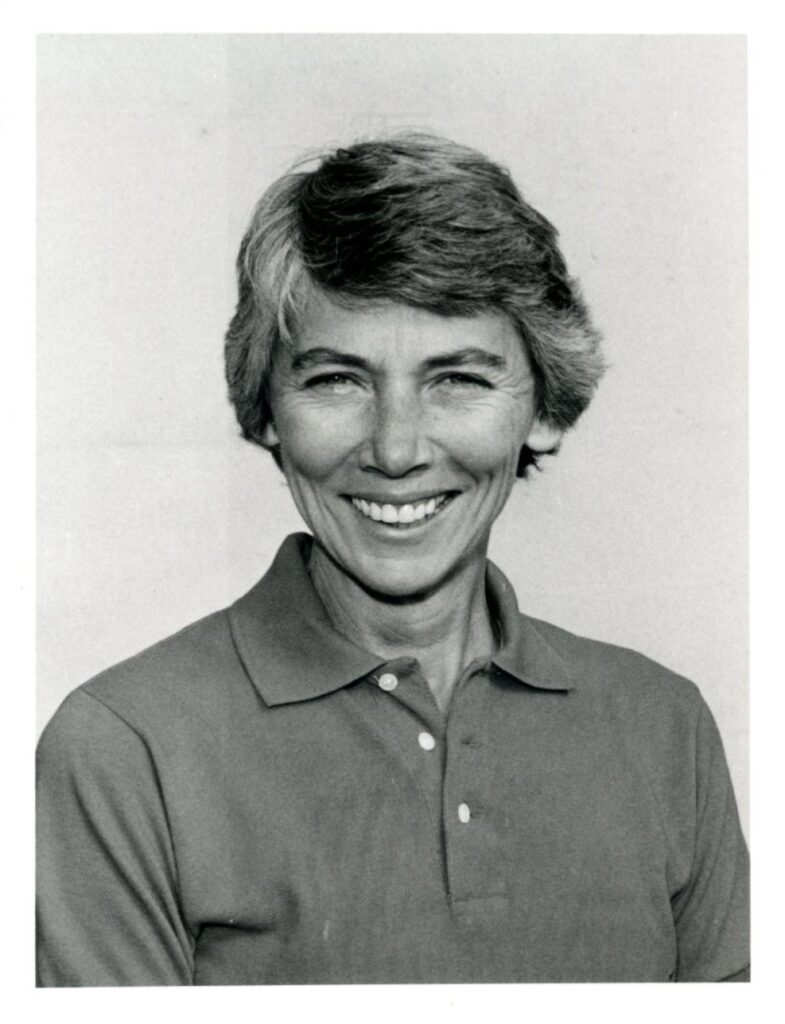
DONNA PICKEL
When Title IX was passed in 1972 providing equal opportunities in college sports for women, participation in sports at many universities was limited to intramural or club programs. A select few determined women drove change and inspired young women to pursue their athletic dreams. One was Donna Pickel. In 1967, the Oklahoma native arrived at Fresno State to teach Pedagogy in the physical education department. Teaching future teachers and not coaching was her priority until 1971 when the women’s basketball coach at Fresno State stepped down. Pickel took the job and in her inaugural season, the Bulldogs won 8 of its first 9 games.
Pickel coached the team for six years then took a year off to complete work on her PhD at the University of Oregon. When she returned to Fresno State, change was taking place. Fresno State was increasing sports opportunities for women. Softball became an intercollegiate sport and Pickel became Fresno State’s first softball coach. Her impact was immediate. The program won a league title in its inaugural season. By Pickel’s fifth season, she had molded the Fresno State softball program into a national power. Her 1982 Bulldogs reached the College World Series for the first time and finished national runners-up.
In the spring of 1985, Pickel chose to retire from coaching. Pickel’s teams boasted 3 league championships and 4 second-place finishes. She concluded her softball coaching career with a 266-120 record. Her winning percentage of .689 was higher than that of almost every other Fresno State coach in school history including Jim Sweeney (.651) and Jerry Tarkanian (.657).
SOFTBALL
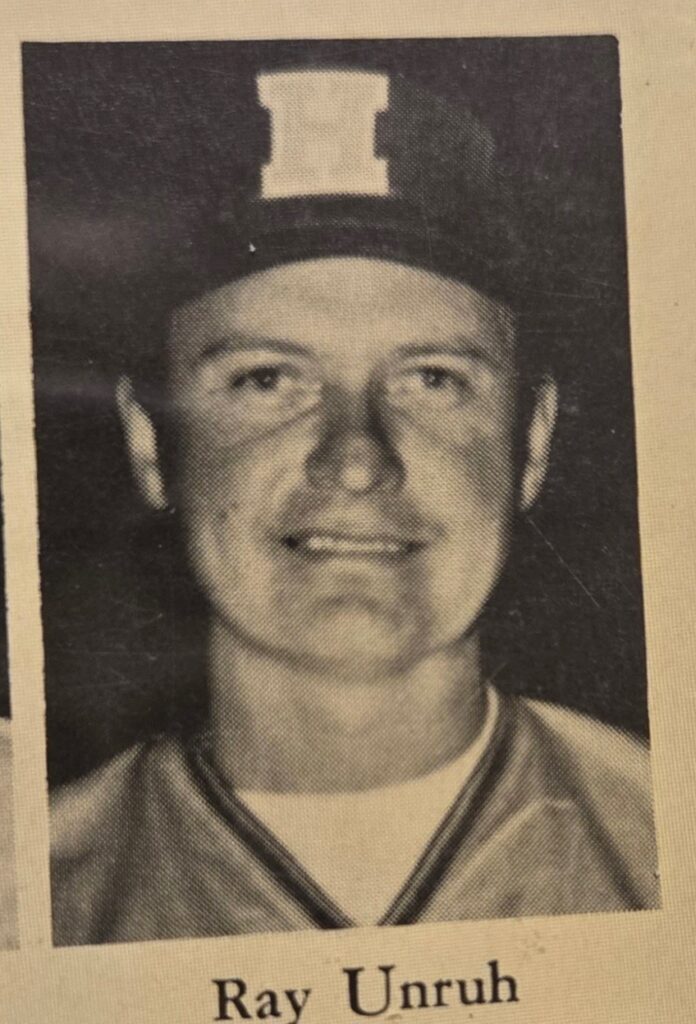
RAY UNRUH
In the early 1950s, fast pitch softball was the undisputed king—and queen—of summertime sports in Fresno County. Sitting in the stands, enthralled by the action, was a Dinuba teenager, Ray Unruh. It would not be long before Unruh was the one fans cheered. In 1952, while a baseball and basketball player at Reedley College, Unruh joined the Dinuba Condors. Soon his college pursuits took a back seat to fast pitch softball. Almost immediately, Unruh became the Condors’ ace pitcher and a power-hitting sensation.
In his third season playing the sport, Unruh’s powerful hitting and adept base stealing helped the Condors win the state and International Softball Congress World Championship where he was named the All-World second baseman. A year later, in 1955, Unruh helped the Condors repeat as state champs and this time, a runner-up finish at the ISC championship event. When the Condors won the 1958 state title, Unruh was named the tournament’s most valuable player. It was a history-making achievement; never before had a non-pitcher earned the award.
FOOTBALL
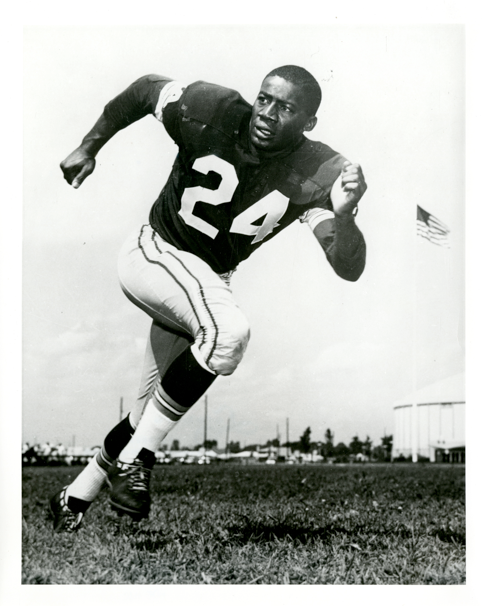
WILLIE WOOD
Never in the ninety-three year history of Coalinga College has a greater talent than Willie Wood suited up for the school’s football team. He arrived in the fall of 1955 from Washington, D.C., where he had been awarded the Bates Trophy as the city’s high school player of the year. A slippery, strong-armed quarterback, Wood’s talent brought college recruiters in droves, but his size—5’9” and 160 pounds—scared them all away. That was just fine with Coalinga College coach Sam Vokes, who turned Wood loose in his T-formation offense and was rewarded with an undefeated 9-0 regular season.
USC was not deterred by Wood’s size. Wood joined the Trojans after one season at Coalinga College and was immediately made the team’s quarterback. Following his senior season, every team in the NFL and AFL ignored Wood in the draft. Wood’s high school coach wrote letters asking teams to give his former player a tryout. Only one replied: Vince Lombardi, head coach of the Green Bay Packers. After a stellar pre-season, Lombardi made Wood his starting free safety. Thus began a legendary 12-year career.
Wood helped Green Bay to 5 NFL championships. He played in Super Bowls I and II, intercepting a pass in the third quarter of the inaugural spectacle. During his career, Wood was named All-Pro 9 times and was selected to play in the Pro Bowl 8 times. In 1975, he was named head coach of the Philadelphia Bell in the World Football League, becoming the first African American head coach in modern pro football history. In 1980, Wood became the first of his race to be a head coach in the Canadian Football League with the Toronto Argonauts. In 1989, he was enshrined in the Pro Football Hall of Fame. Wood passed away in 2020 at the age of 83.
HAROLD ZINKIN AWARD / SOCCER
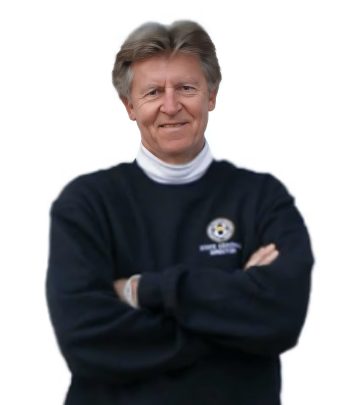
KARL DEWAZIEN
Between 1975 and 1988, youth participation in soccer grew at the staggering rate of 1300%. One man whose work played a part in that remarkable growth is Karl Dewazien, the 2025 recipient of the Harold Zinkin Award for contribution to youth. Dewazien’s impact began in 1978 when he was hired as State Director of Coaching by the California Youth Soccer Association. Prior to that, he had been head coach at Fresno Pacific, a role he took on while only a sophomore at the school, making him perhaps the only student player-coach in college athletics.
With CYSA, Dewazien was responsible for training coaches and inspiring a love of the game in young people. Along the way, he developed unique teaching methods, terminology, and a distinct methodology. To further inspire coaches and young players, Dewazien collaborated with Fresno artist Joe Garcia to produce six books on soccer instruction. These books have been translated into several different languages for sale around the world. It is estimated that 17% of the seventy-three million people under the age of 18 in America will touch a soccer ball during a given year; many have been inspired to do so by Karl Dewazien.
BASEBALL / TEAM
1965 – 1968 SELMA HIGH BASEBALL
In the latter half of the 1960s, the baseball program at Selma High School achieved one of the rarest feats in the history of area high school baseball. The Bears won not one, not two, but four consecutive Sequoia Division valley championships. The driving force behind the success was the team’s coach, Alan Cropsey. A disciple of legendary Fresno State coach Pete Beiden, Cropsey prioritized fundamentals and sound baseball skills.
What helped make the 1965 team better was added experience and the arrival of a sensational freshman, Lloyd Allen. Behind the pitching of Allen (8-2, 0.85 ERA), junior Tom Martinez (9-1) and the hitting of Ed Zamora (.338), Selma reached the title game against Lemoore where Allen struck out 19 and the Bears claimed the valley title 5-1. The following season, the Bears made it back-to-back titles by defeating Arvin High 3-2. In 1967, Selma claimed their third consecutive valley title 5-4. In 1968, Allen helped the Bears to another league title and a victory over Dos Palos to claim their fourth consecutive championship. Following the season, Allen was selected in the first round of the baseball draft by the California Angels, beginning a seven-year big league career.